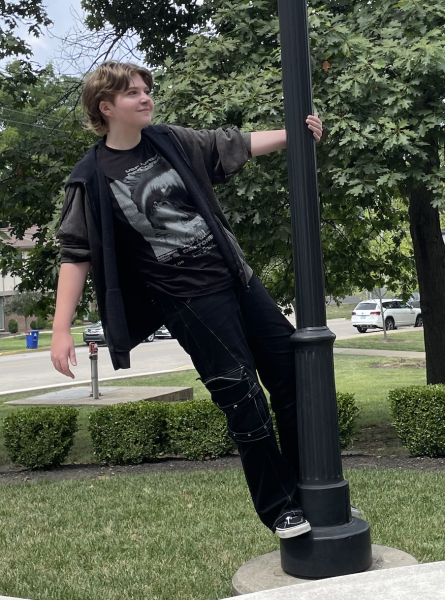

On a late, starry night in Cincinnati, teens walk the streets as the rest of the city settles down for the night. Across the deep blue river sits Fort Thomas, where nighttime routines take on a slightly different pace.
The City of Cincinnati is enforcing stricter curfew laws due to an uptick in deviant adolescent behavior. In August, Cincinnati City Council passed Ordinances 265 and 266, setting curfew from 11:00 p.m. to 5:00 a.m. for individuals 18 and under, with a much stricter curfew of 9:00 p.m. in Downtown Cincinnati and other places.
The tighter curfew laws in Cincinnati are meant to keep minors off of the streets at night and curb youth involvement in violent crime. City data shows that 24 juveniles have already been shot so far this year, including five fatalities. This shows an increase from this time in 2024, with 19 juveniles shot, two fatally.
Despite this, Enforcements deal with challenges executing city curfew laws for teenagers, such as officers identifying minors and housing the minors as needed.
Many officers cite that juvenile crime has increased, prompting a stronger need for tighter curfew laws. Local school officer Zac Rohlfer agrees, noting the need for additional action.
“…I think juvenile crime has increased, and I’ll say that we’ve even seen an increase in juvenile crime in Fort Thomas… I think the whole county has probably seen an uptick in crime from juveniles… I think other things need to be done… to really curb juvenile crime,” Rohlfer said.
As Cincinnati enforces these curfew laws, Fort Thomas residents are watching closely. Many worry whether changes are coming to the community. Additionally, some wonder if curfew laws truly improve safety or just limit teens’ freedom.
Health teacher Kyle Finfrock considers whether stricter curfews restrict teens’ freedom.
“I think they do because they’re not able to run around on the streets past a certain time,” Finfrock said.
In addition to faculty and enforcement, students like Suntae Warf (9) have forward opinions on whether stricter rules truly make teens safer or simply restrict them.
“Well, I know there are more crimes in Cincinnati than we have here, and I feel like the curfew, if enforced a lot and heavily, can help the crime rate go down because people tend to commit more crimes at night than they do in broad daylight,” Warf (9) said.
Hunter Cole (9) believes the curfew laws may lack enforcement, and therefore, effectiveness.
“It depends on if it’s [curfew laws] enforced or not. I doubt it is, so no, I don’t think it stops anything,” Cole (9) said.
Warf (9) expands on Cole’s (9) ideas, explaining that even if the law is enforced, people will still sneak around it.
“I’m just saying it hasn’t, doesn’t stop people unless you really enforce them and you stick to it. But most of the time, they’ll still do it anyway. They’ll just get more sneaky,” Warf (9) said.
Nonetheless, Cincinnati City Police continue to make a valiant effort to curb youth and city crime.
Although this may prompt Fort Thomas city legislature to consider adopting curfew laws for minors have remained unchanged since 1966. They are, as cited in Title XIII, Chapter 131.02 of the City of Fort Thomas, Kentucky Code of Ordinances:
“The hours between 11:00 p.m., prevailing time, on any Sunday, Monday, Tuesday, Wednesday or Thursday and 6:00 a.m., prevailing time, on the following day…. [and] The hours between 12:01 a.m., prevailing time, and 6:00 a.m., prevailing time, on any Saturday or Sunday.”